
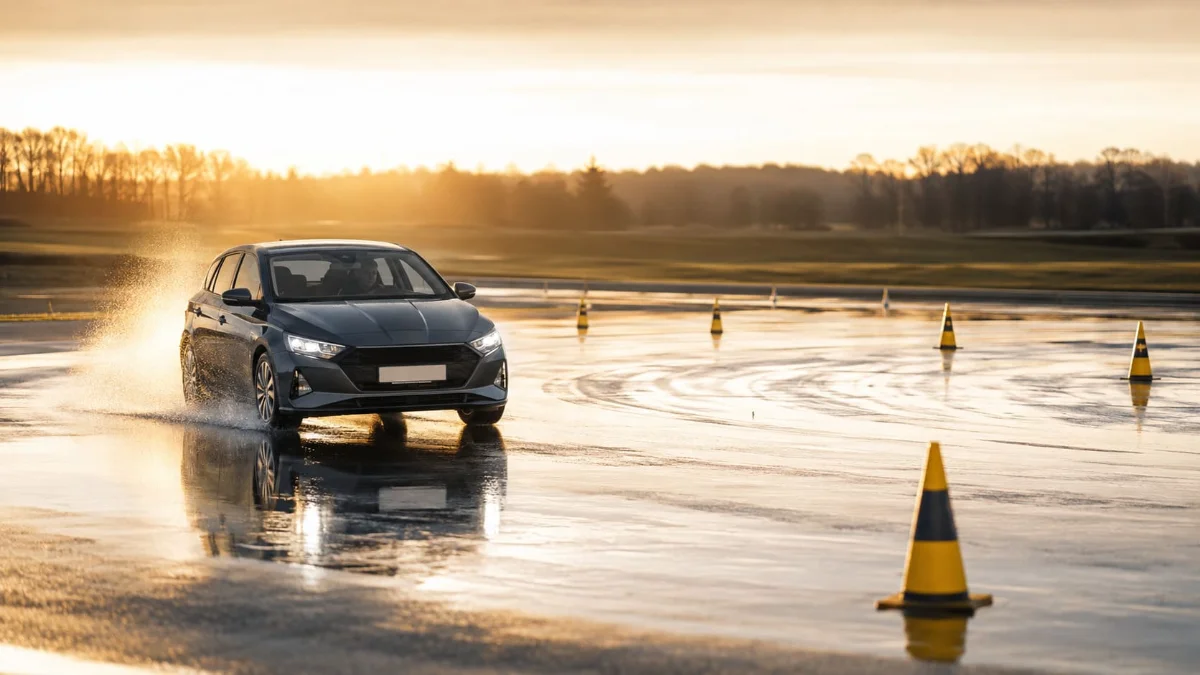
Skid Control Training: More Than Just Driving on Slippery Roads
Skid control training is often associated with slippery roads, hard braking and a car that suddenly reacts differently than expected. But training on a skid pan is about much more than learning how to handle a car when grip is reduced.
One of the most important lessons is understanding how quickly your options as a driver change when your speed increases, road grip becomes poorer or something unexpected happens in front of you.
Skid control training is therefore an important part of getting your driving licence for a car. It gives you the opportunity to experience potentially critical situations under controlled conditions instead of encountering them for the first time alone on a public road.
What is the purpose of skid control training?
In the Danish driving education system, skid control training takes place at what is officially known as a køreteknisk anlæg, or driving technical facility.
The purpose is not to teach advanced driving techniques or make you better at driving fast. Quite the opposite.
The training is designed to help you understand how a car reacts in critical situations and to demonstrate how much speed affects your ability to brake, steer and avoid obstacles.
For example, you may experience the difference between performing a manoeuvre on a surface with normal grip and completing the same manoeuvre on a more slippery surface. This makes theoretical concepts such as speed, grip and braking distance much easier to understand in practice.
The most important lesson is understanding the limits of the car
When you are a new driver, a modern car can feel extremely stable. This can create the impression that the vehicle will almost always respond exactly as you expect.
But every car has limits.
If your speed is too high for the conditions, good tyres, ABS and electronic safety systems cannot overcome the laws of physics. During skid control training, you get the opportunity to experience these limitations without having to discover them during a dangerous situation on a public road.
The training can make you more aware of:
how speed affects your ability to react
how much road grip can change the behaviour of the car
how the car reacts during heavy braking
how steering and braking affect the vehicle
when an evasive manoeuvre becomes difficult
why identifying a potential hazard early is so important
Small changes in speed can make a big difference
One of the most important experiences from skid control training is seeing the relationship between speed and control.
As a driver, it can be difficult to intuitively judge how much even a relatively small increase in speed changes the outcome of a critical situation. This is why the training involves different speeds and different levels of road grip.
The lesson is not simply that you should drive more slowly when the road is slippery. It is about developing an understanding that the appropriate speed always depends on the conditions.
Rain, snow and ice are obvious examples, but road grip can also be affected by leaves, gravel, the condition of the road surface and other factors.
You learn how to react without panicking
A critical situation in traffic rarely occurs at a convenient moment. A vehicle in front of you may suddenly brake, an obstacle may appear on the road or your car may begin to lose grip.
If you have never experienced how a car reacts in such a situation, it can be difficult to know what to do.
During skid control training, you experience these reactions in controlled surroundings. An important part of the training is to give you practical experience with critical situations and reduce the risk of inappropriate panic reactions.
You will not become an expert after a few hours of training. But you will gain an important point of reference. You will have experienced how the car reacts and how quickly a situation can develop.
Skid control training connects theory with practical driving
Many of the concepts you encounter during theory lessons can feel relatively abstract when they are only explained on a screen or in a classroom.
On the skid pan, many of these concepts become physical experiences.
You may already have learned about grip, braking, speed and risk during your theory lessons. When you later experience the consequences from behind the steering wheel, it becomes much clearer why the rules and recommendations exist.
Skid control training should therefore not be seen as an isolated activity. It forms part of the complete driving education for category B, where theoretical knowledge and practical experience build on each other.
Is skid control training mandatory in Denmark?
Yes. For an ordinary category B driving licence in Denmark, training at a driving technical facility is a mandatory part of the driving education programme.
The training includes practical lessons in which you drive the vehicle yourself and complete exercises designed to demonstrate how the car behaves under different conditions.
Skid control training takes place towards the end of your driving education, when you have already gained experience with ordinary driving and the central manoeuvres required on public roads.
If you would like to know more about the duration itself, you can also read our separate guide about how long skid control training takes.
Do you have to pass skid control training?
Skid control training is part of your practical education rather than a separate driving test like the final practical examination.
However, that does not mean that you simply have to show up. The relevant exercises form part of the mandatory training programme and must be completed as required.
You therefore do not need to arrive expecting to perform every exercise perfectly from the beginning. The purpose is precisely to learn through experience and develop a better understanding of both the car and your own reactions.
What can you take from the skid pan into everyday traffic?
The most valuable lessons from skid control training often become apparent only after you have received your driving licence and begin driving independently.
In everyday traffic, you will rarely need to reproduce exactly the same manoeuvre you performed during training. Instead, the value lies in the understanding those exercises have given you.
For example, you learn that:
reducing your speed early is better than trying to rescue a situation at the last moment
road grip may vary even when the road appears normal
keeping sufficient distance from the vehicle ahead gives you more options
every car has physical limitations regardless of how modern it is
calm and controlled driving gives you more time to react
It is this understanding of risk that makes skid control training valuable long after you have received your driving licence.
Skid control training as part of your driving licence at Brøndby Køreskole
At Brøndby Køreskole, the mandatory elements of the Danish driving education programme are integrated naturally into your overall course.
The goal is not simply to prepare you for the driving test, but also to give you a solid foundation for the driving you will do afterwards.
If you have not yet started your driving education, you can read more about our category B driving licence course or see your options for enrolment.
If you have questions about skid control training or the driving licence process in general, you are also welcome to contact Brøndby Køreskole.
Frequently asked questions about skid control training
What do you learn during skid control training?
You learn about the relationship between speed, road grip, braking and steering. You also experience how a car reacts in critical situations, helping you develop a better understanding of both the vehicle's limitations and your own reactions.
Is skid control training mandatory in Denmark?
Yes. Training at a driving technical facility is a mandatory part of the Danish category B driving education programme.
What is a skid pan?
A skid pan is a controlled training area where drivers can experience reduced grip and practise braking, steering and handling critical situations safely. In Danish driving education, this training takes place at a køreteknisk anlæg.
Is skid control training a test?
No. Skid control training is not a separate driving test. It is mandatory practical training designed to give you experience with the behaviour of the car in critical situations.
When do you complete skid control training?
Skid control training normally takes place towards the end of the Danish driving education programme, after you have completed the preceding parts of your practical training.