
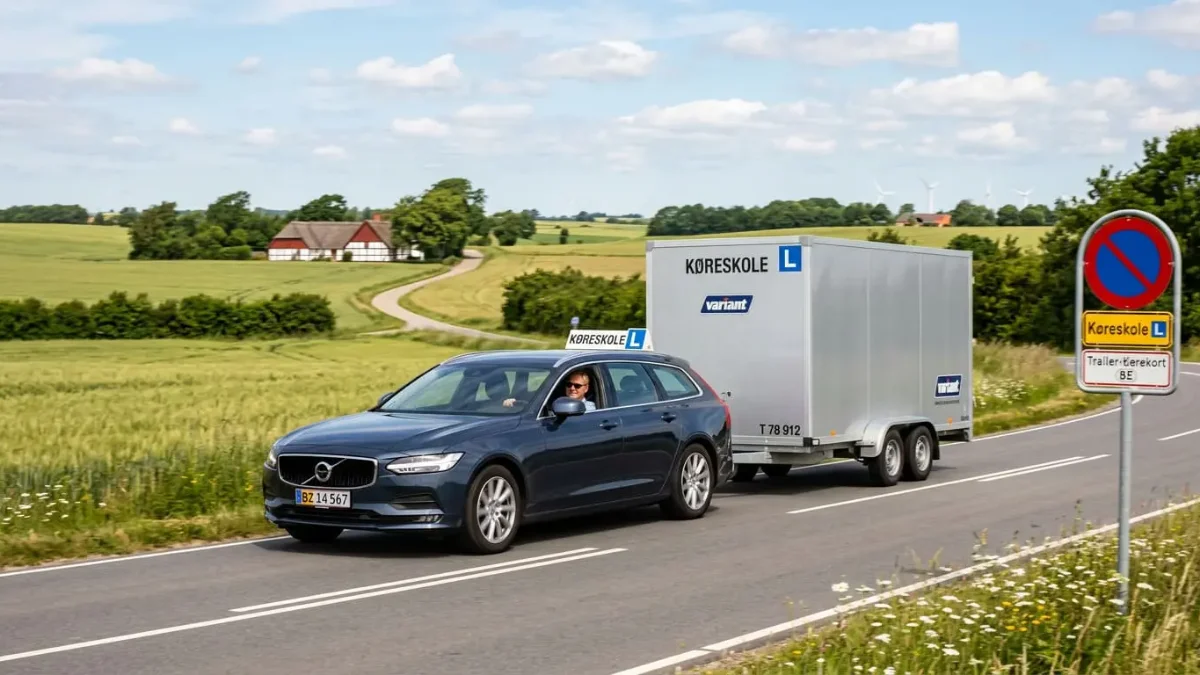
A trailer licence becomes relevant when an ordinary car driving licence is no longer enough for the trailer or vehicle combination you want to drive. This typically applies if the trailer is heavier, if the total combination weight gets high, or if you want to be sure you are complying with the Danish trailer licence rules in practice.
Many people search for trailer licence, licence for a trailer and large trailer licence, because the rules can be hard to make sense of. This is mainly because it is not only about what the trailer weighs in use, but also about the permitted total weight, the car's coupling weight and the combined weight of car and trailer. That is why it is important to know the rules before you hitch up and drive off.
What is a trailer licence?
A trailer licence is an extension of the ordinary category B licence. With a normal category B driving licence you may drive a car and, in many cases, also tow a trailer, but only within certain weight limits. When those limits are exceeded, either B+ or BE is required.
With an ordinary category B licence you may, as a starting point, tow a trailer with a permitted total weight of up to 750 kg, as long as the overall combination does not exceed 3,500 kg. If you want to drive with a heavier trailer or a heavier combination, you need to look at whether you need B+ or BE.
B+ allows a vehicle combination of up to 4,250 kg, while BE allows a vehicle combination of up to 7,000 kg. It is therefore mainly BE that people mean when they talk about a trailer licence in the ordinary sense.
Trailer licence rules: when is it required?
The most important trailer licence rules concern three things: the trailer's permitted total weight, the car's coupling weight and the total combination weight. It is not enough to consider whether the trailer seems light. You need to look at the approved weights in the registration certificates and on the vehicles' identification plates.
If you only hold category B, the total combination may as a rule not exceed 3,500 kg. If the limit is exceeded, an extension is required. The choice here will typically be between B+ and BE, depending on how heavy the combination is.
In practice this means you may need a licence for a trailer in situations such as:
- driving with a large enclosed trailer
- transporting building materials or machinery
- driving with a horse trailer
- driving with a larger caravan
- transporting a boat or other heavy equipment
If you often drive with a heavy trailer, it is an advantage to know the rules precisely. It reduces the risk of mistakes and makes it easier to assess whether you may legally drive with the specific combination.
Trailer rules for licences issued before 2009
One of the most searched topics is trailer rules for licences issued before 2009. Here a special Danish rule applies to category B licences issued before 1 May 2009. If you hold such a licence, you can in some cases drive in Denmark without a trailer licence, even though the trailer's permitted total weight is higher than the normal limits would otherwise allow.
The decisive factor is that the car's permitted total weight plus the car's maximum permitted trailer weight does not exceed 3,500 kg. This may, for example, be relevant if the car has a permitted total weight of 2,000 kg and a maximum permitted trailer weight of 1,500 kg. In such a case the combination can be legal in Denmark without an additional trailer licence, even though the trailer's own permitted total weight may look high on paper.
There are, however, important reservations. The rule only applies in Denmark, and it is necessary to carry the registration certificates for both the car and the trailer. In addition, the car and the trailer must be approved for inspection-free coupling. This rule should therefore never be relied upon from memory alone. The documentation must be in order.
The difference between B, B+, BE and C1E
When you look into a large trailer licence, you quickly come across several different categories. Here is the difference in practice:
Category B
The ordinary car driving licence. Here you may drive with a trailer within the ordinary weight limits, and the combination may as a rule not exceed 3,500 kg.
Category B+
An extension of category B that makes it possible to drive a combination of up to 4,250 kg. B+ is used less frequently than BE and is often regarded as a more limited solution.
Category BE
The most relevant category for most people who are looking for a trailer licence. With BE you may drive a combination of up to 7,000 kg. This makes the category well suited to heavier trailers and more demanding transport tasks.
Category C1E
This category applies to a small lorry with a trailer and can give access to a combined total weight of up to 12,000 kg. It is usually only relevant where heavier commercial transport is involved and requires both B and C1.
Trailer licence price
The trailer licence price can be found under the section for the trailer licence. The price can normally cover theory, practical lessons and tests, but it is important to look closely at what is specifically included.
In addition to the tuition itself, there may be extra costs for, among other things:
- a medical certificate of around DKK 500
- a stamp fee or charge of around DKK 360 to 460
The total trailer licence price therefore depends not only on the advertised package price, but also on the statutory surcharges and any extra lessons. When comparing prices, it is therefore a good idea to look at the overall programme rather than just the starting price.
When does a large trailer licence make sense?
A large trailer licence makes sense when you often drive with heavier loads or want greater flexibility in everyday life. It can be relevant for both private individuals and businesses.
For private individuals this often applies when transporting a caravan, horse trailer, boat trailer or larger removal load. For tradespeople and other occupational groups it can be necessary when transporting machinery, materials or equipment, where an ordinary trailer solution quickly becomes too limited.
This is also where BE is often more obvious than B+. B+ may be sufficient in some cases, but BE typically gives more room to manoeuvre and fewer restrictions. That is why many people choose the solution that also holds up in the longer term.
How to assess whether you may drive with a trailer
If you want to find out whether you may drive with a particular trailer, you should not guess. Instead, you should check the following:
- the car's permitted total weight
- the trailer's permitted total weight
- the car's maximum permitted trailer weight
- the total combination weight
- which driving licence category you hold
It is precisely the combination of these factors that determines whether you can manage with category B, or whether you need a trailer licence. If in doubt, it is a good idea to use a trailer calculator, so that the assessment is made on a correct basis.
Conclusion
A trailer licence is relevant when you want to drive with heavier trailers and larger vehicle combinations than an ordinary category B licence permits. The key trailer licence rules concern permitted total weight, coupling weight and total combination weight. If you hold a category B licence issued before 1 May 2009, a special exemption may apply in Denmark, but it requires the documentation to be in order and should be assessed carefully.
When you look into a licence for a trailer, it is therefore important to consider more than just the size of the trailer. The right solution depends on the specific combination of car and trailer. For many people BE will be the most flexible solution, while B+ only covers a more limited range. And when it comes to the trailer licence price, you should always look at both the course price and the extra fees that come with it.